When I catch a cold, it normally runs the same course - four days of shivering sneezing misery followed by four weeks of getting rid of the gunk which clogged up my tubes (sorry to those of a sensitive disposition!). So it has been with me this last fortnight, and I've been catching a cold financially too.
I took out an ad in the Independent on Sunday on 13th March, and wished I hadn't bothered. The ad agency had contacted me with the offer of a panel, which had become available due to cancellation by someone else, at the bargain rate of £185 + VAT, as opposed to the "normal" rate of £600 + VAT. Their circulation figures were around 700,000, which is certainly a lot more than that of the special interest mags in which I've advertised up to now. I went for it, as I've been considering advertising in one of the "big" papers for some time (just to see what would happen!), and I probably wouldn't get a better deal than the one which was being offered. They designed a beautiful panel for me, and it duly appeared in the magazine section of the paper (at the foot of a page of similar-sized ads). My website viewing log showed the poorest figures for a month that day, so I now KNOW this doesn't work!
In anticipation of the increase in sales which the advert would produce, I had invested another £200+ in new stocks of greeting cards and giclee prints. I have sold a few of these lately, but not in a quantity which would justify the expense I've incurred over it. Then, on Saturday 12th March, my computer desktop monitor packed up, and I had no option but to replace it , at a further cost of £150. Ouch! For a self-employed artist on a very modest income, an outlay of £600 over the course of a single week, before I'd even bought myself something to eat, is a fairly serious matter.
Thank goodness it hasn't been all bad news. My client loved the painting of the ill-fated fishing boat "Kildonan" (see posting 28/02/2011), and I've received a commission to do a number of "Nort Boat" paintings for the St. Magnus Bay Hotel in Hillswick. I've now started this, with the "Sovereign", a paddle steamer which was one of the earliest in the fleet, having been acquired in 1836 and running on the Aberdeen - Shetland route until 1867, when she was wrecked near Aberdeen.
I've been working steadily on the stock/exhibition works too. I've nearly finished a Howe o' the Mearns landscape, and have begun another seascape with an "under sail" theme, which has a dual purpose in that the 2012 Tall Ships race is visiting these islands in July. I expect I'll be getting some themed greeting cards and giclee prints for that event too.
Aaaachoo!
The Grumpy Old Artist
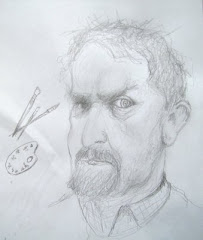
Would YOU pose for this man???
Exhibition Poster

Catterline Event, 2011
Oil Painting by Jim Tait
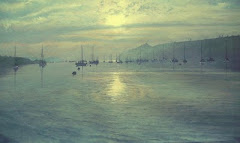
Helford River, Cornwall
Oil Painting by Jim Tait
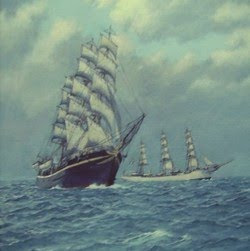
Full-riggers "Georg Stage" and "Danmark"
Other Recent Works
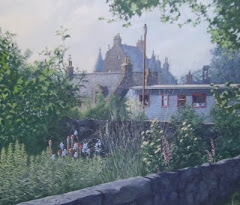
Fordyce Castle and Village

Hay's Dock, Lerwick

Shetland-model Boats at Burravoe, Yell
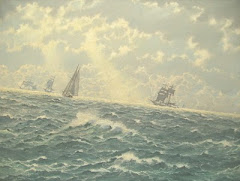
Tall Ships Seascape

The Tour Boat "Dunter III", with Gannets, off Noss
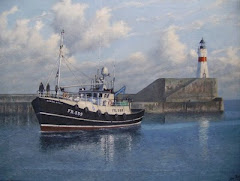
The "Karen Ann II" entering Fraserburgh harbour
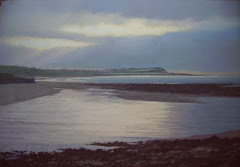
Summer Evening, Boyndie Bay
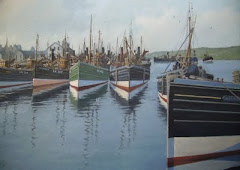
1930s Lerwick Harbour

Johnshaven Harbour
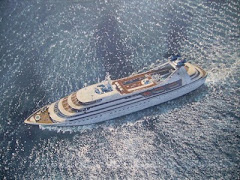
"Seabourn Legend"
Greeting Cards!

Now Available in Packs of Five or in Assorted Sets of Four
Sunday, 20 March 2011


Monday, 7 March 2011
HAZARDS OF SEAFARING

This is my version, in oils on canvas, of the Shetland fishing boat "Kildonan", passing the Bressay lighthouse as she approached Lerwick harbour. She would have done this many times in her short career. She was a 50-odd foot "zulu", built originally as a sailing vessel, and had been fitted with a wheelhouse and a diesel engine, as many of this class of boat were, in the years just following the first world war. One early summer morning in 1932, her crew had just finished hauling a good shot of herring, and one of the two brothers who owned the boat went down to start the engine for the short voyage back to the market at Lerwick. Instead of starting in the usual manner, it went on fire, the blaze spread quickly, and the crew had no option but to abandon ship and take to the small boat to watch their livelihoods go up in flames before their eyes. The skipper, whose daughter (now aged 80) commissioned the work from me, once said that the saddest sound he had ever heard was that of the drift-net buoys bursting in the intense heat.
No doubt fire-fighting equipment was much less sophisticated in those days than that carried as standard and by regulation now. In addition, there are the many other modern safety devices, without which no present-day skipper would ever even consider putting to sea. Some of this is electronic, some connected with advances in other fields of technology and communication, such as the EPIRB (Emergency Position Indicating Radio Beacon), whose prosaic title bears similarities to the "does exactly what it says on the tin" advertising slogan, all of it designed to improve the safety of mariners at sea.
And then there is, but not for much longer in its present form apparently, the Coastguard, a worthy organisation of people dedicated to keeping seafarers healthily afloat. They, being local to their station, know the coastline and the inshore waters in their local areas intimately, and have representatives on call at all times to deal with any emergency which may arise (and frequently does). Their radios and other points of contact are constantly manned to pick up signals from any vessel which might be in trouble, and they normally take control of any rescue operations which may have to be mounted in their areas, be it a ship in distress, a cliff fall or stranding (man or beast!), or a missing shore walker. In short, if anyone's safety is compromised, either at sea or near the shoreline, the coastguard is there to use its local knowledge and skills to put an effective rescue plan into motion.
Until now, that is. In order to save a few million quid, the coalition government wants to shut the local coastguard stations (the few that are left) down. Hapless beleaguered-looking representatives have been despatched to the various locations where the doomed stations are situated, with the remit to persuade the turkeys that voting for Christmas IS a good idea, that closing the stations is a wonderful scheme which will make the system SO much more efficient, and is NOTHING AT ALL to do with the fact that our rulers need to recoup the huge sums dished out to senior bankers as a reward for practically bankrupting the country, and putting seafarers' lives at risk is a price worth paying for this. They are having difficulty selling this to the natives, however. The deal is this - there will be one fully manned technology-driven unit in Aberdeen, and one other part-time 9 to 5-opening one at either Stornoway or Lerwick (fight amongst yourselves for that one, folks!). Tough if your job takes you to sea outwith these hours, as most seafarers' jobs do! Are there really people in Regulationville who think that seamen finish their eight-hour shift, change into their casuals and have a pint in the pub on the way home to the wife and kids?
Then there were the coastguard tugs (now off contract, I believe, and in the process of getting repainted for their new jobs), which were introduced in the aftermath of the "Braer" oil spill. They were to cover the sea areas around the Western and Northern Isles, to take broken-down ships (of which there have been many) in tow, thus guarding our coastlines against pollution, and crews' lives from being lost at sea in these busy areas. I almost laughed out loud when I heard about the Royal Navy nuclear submarine HMS "Astute" grounding off the Gairloch last year, and having to be towed off by one of the very ships they want to get rid of!
Of course, closing Coastguard stations is nothing new. The last government got rid of the Orkney station, amongst others, and in England, the National Coastwatch Institution, http://www.nci.org.uk/ was set up in 1994 as a kind of substitute for defunct Coastguard units. It is entirely staffed by unpaid volunteers and supported entirely by voluntary contributions (rather like the RNLI, it seems), but this body has no representation north of the border as yet, as far as I know. I hate the idea of this really, as it appears to let a Government of knaves and charlatans get away with their incompetence, mismanagement of resources, and callous indifference to the wellbeing of sailors and others who rely on them for a degree of protection. Once again, an essential service is being sacrificed on the altar of capitalism and consumerism. This is what David Cameron calls the "big society", after all - people who will work for nothing and let him "off the hook", to use a fishing expression.
Comparing the summer of 1932 with the present day in terms of safety at sea is not easy, and there are few similarities. Marine diesel engines were at an early stage of development back then. Rescue equipment was limited to a wooden lifeboat, a few lifebelts, the strong arms of the fishermen themselves and anything else that came to hand at the time! Nowadays there are advances in technology and safety devices too numerous to list here. This is just as well, for this government has made it clear that, as far as it is concerned, we could be back to the 1930s. The sea is still as dangerous a workplace as it ever was, and I hope that every time a life and/or a livelihood is lost with this evil coalition's tacit approval, they are left in no doubt of the fact. I am sure that the media, in its various forms, will be delighted to assist!
Sunday, 27 February 2011
THE FIFTH AMENDMENT!

I reckon that's the number of times that I've made alterations to this painting over the six years since I first produced what I thought was a good representation of the MV "St. Clair".
She was completed in 1960 by the long-since-closed Hall Russell's shipyard in Aberdeen. She was the third ship to bear the name for the North of Scotland, Orkney and Shetland Steam Navigation Co. Ltd., and she turned out to be the last before this firm was taken over by Coast Lines Ltd in the mid-1960s, and this company was absorbed into P & O Ferries early in the 1970s. She was also the last side-loader on the route (the next "St. Clair" being the first ro-ro ferry), and consequently she was the last ship to use Victoria Pier for loading and discharging of passengers and cargo. I took my first trips to the mainland as a student on this ship, and I have many happy memories of wild nights on board.
The painting has spent most of the time since 2004 on the wall of the Lounge in Lerwick, and every time I looked at it, I knew that it needed more work done on it. The fifth, and, I hope, the last, changes were made to it about a week ago. I altered the sky, the angle of the horizon, the distant Sumburgh Head, and the sea behind and in front of the ship this time. I've been looking at the work off and on for the last week, and, for the first time, I have a sense of satisfaction about it. I hope and believe there will be no sixth amendment to this particular painting.
Wednesday, 16 February 2011
MORE TERMINOLOGICAL INEXACTITUDES!

Yet more obsequious hand-wringing after the manner of Charles Dickens' character Uriah Heep (as illustrated by my drawing of my impersonation of the revolting chap!) is required. I just keep making mistakes and, unlike most of today's politicians, I'd prefer to admit to them! They usually end up costing me money too.
After telling you about my brilliant scheme to prevent ridging to my canvases being caused by the edges of the stetcher frames, using draught excluder strip, I invested in a couple of rolls of this product, only to discover that it was far too narrow for this purpose, and it was also self-adhesive, which is not a desirable property for my purpose either. So, another £7-odd wasted, unless I need a draught excluded at some point in the future.
Back to the drawing board, to coin the popular cliched phrase! I googled condensation sponge strip, and up came (amongst other things!) Drip Strip! Eureka! I bought some, I've tried it, and it works! It'll work even better when I refine the technique of applying it a bit.
More apologies for late posting, but I had to prioritize tasks, such as hanging my Lounge Bar mini-exhibition, which had been removed so that the pub owners could redecorate the place. I also had to update the website with recent works (http://www.tait-gallery.co.uk/), which is now done - I think! Uploading the images, creating thumbnails, using the Image Manager and doing all the necessary hyperlinking is tricky for an internet comparative newbie like me.
As to current artworks, progress is much as usual - slow but steady! I've begun modifying one of the Lounge mini-exhibition items. It was of the third ship to bear the name "St. Clair" on the Aberdeen to Shetland cargo/passenger route. I'd depicted her with Sumburgh Head in the background, but I'd made the land too close up, and this had been irritating me for years, so at last I'm doing something about it. I plan to work at this today. I'm working on another historical Shetland fishing boat commission, and I've begun a largish (40" x 20") painting of the Mearns, near Luthermuir, in April, when fields of daffodils can be seen giving the landscape striking bands of yellow against the dominant dull browns and greens. My next exhibition at the Creel Inn, Catterline, later this year, is the intended destination for this
work.
The days are visibly lengthening now, which is good for artwork production, although the weather is certainly not improving. We had storm force winds bearing rain across the islands for most of Monday, although yesterday was bright and mostly dry, if a little windy. The Met Office are forecasting snow for today. It's all part of the rich tapestry of life on my native islands, and I wouldn't have it any other way. Have a good week (what's left of it!) and I'll try to do better with my posting schedule in future!
Tuesday, 8 February 2011
GOURDON HARBOUR, DRAUGHT EXCLUDER AND MR MUSCLE

Here's the latest work to become part of the "stock" at the Tait Gallery. It depicts workboats and pleasure craft at their moorings in the inner harbour at Gourdon, on the east coast of Scotland just south of Inverbervie. This painting took a long time to complete, as it was always competing for time with concurrent commissioned works.
I've devised a cunning plan to solve a ticklish problem I've been confronted with of late. It concerns the cheaper range of ready-made stretched canvases which are obtainable from all the best art materials suppliers. Ridges keep appearing in the canvas at the edges of the stretcher frames, caused by the tension in the material easing when brushwork is applied vigourously to the surface. The solution is so simple that only a numpty like me could have taken as long to fathom it out - draught excluder strip! You know, the kind of old inch-wide spongy stuff which used to be sold in rolls, and which my Dad used to lay on the sills of the old single-glazed windows to collect water caused by condensation, and which could be wrung out and replaced as necessary (the strip, that is!). The technique, as I envisage it, will be to place the strip along the back of the stretcher frame, close to the offending edge, with perhaps a little light adhesive to secure it, and tuck in the loose edge underneath, thereby cushioning the edge which causes the ridging. It sounds wonderful in theory. I expect to make my appearance on one of these awful DIY TV programmes soon. People have often suggested that I take art classes, but with much Uriah-Heep-like hand-wringing, I have explained that I have no teaching qualification and that I have learned all my skills in the school of hard knocks and split ends.
Of course, in these modern days of double-glazed windows, such products as I've described above are now largely redundant, but there are still a few online retail outlets which sell it online. (Mind you, when you google "sponge strip", you get some interesting results!) There you go, Petal! - yet another exciting piece of improvisation from the brilliant but tortured mind of your friendly artistic curmudgeon! Another thing - if I spent a bit more money on better-grade heavier canvas, the ridging problem would not be so acute. As my old Aberdeen mill foreman used to say; "Aye, Jimmy - if ye buy cheap, ye buy dear!" (I seem to recall he was referring to footwear at the time, but never mind).
My apologies for not posting on Sunday as usual. That day I had decided to spend a day of frantic effort to get some cleaning done in the flat/studio (conditions must have been bad before even I had noticed them!). By the time I had hoovered, wiped, dusted, sprayed, scrubbed, washed and dried my way through most of Sunday, I was mentally, physically and emotionally drained, not to mention reeking of Mr Muscle. I was incapable of composing a half-decent blog post, but my cooker, bath and sinks were gleaming!
All the best from a pristine (I wish!) Tait Gallery.
Sunday, 30 January 2011
SITTING AND WAITING
I'll have to get out more. Up-Helly-A' and the coincidental Burns Night passed by last Tuesday without any participation by me whatsoever, although the Tait Gallery is now on the collecting sheet for the former. My sister Angela, who is normally resident at Bethesda, North Wales, informs me that the 25th January is also the date of Diwrnod Santes Dwynwen, a kind of Valentine's day for the Welsh. Whatever the occasion, I can't be bothered to attend it nowadays. Sad, isn't it?
Sitting has always been one of my favourite pastimes. I just park myself, preferably near a window with a view, and switch off, allowing myself to be transported to wherever my flights of fancy might take me. And there I remain until the unwelcome intrusion of a phone call, a knock at the door or a work deadline encroaches upon my reverie. To tell the truth, terra firma is not such a fearful place for me as it used to be (would that it was the same for everyone). A year into my self-employment, around the end of 2005, I reckon I was over £10,000 in debt, and with no real idea how I was going to get this paid off. Now I've managed to work myself clear of three-quarters of that sum, and I hope to be rid of it completely by the close of 2011.
During the 1990s and into the "noughties", a recurring nightmare used to invade my hours of slumber. It varied as to its "geographical" location, but the theme was always the same. I was always among a crowd of people, I was always trying to accomplish some task or other, and I was always failing miserably. Frequently the location was a grotesquely enlarged version of the Vadill Compounds during the construction phase of the Sullom Voe Terminal, among the mud, sheds, workshops and portakabin offices of this period and area. It was dark, and I was trying to find someone, which I never did, of course. Sometimes it was a flat, which may have started as a similar one to that in which I now type these lines, but in my dream it took on much larger proportions, with loads of interconnecting rooms. I was the official tenant, I was trying to rid myself of the crowds of people who seemed to have taken up residence in it, and no-one was taking a blind bit of notice of me! Walking up B Avenue, again at the oil terminal, towards the flares, with crowds of people walking down, was another theme. I think I was looking for a lift somewhere (it made sense in the dream!). Those and many others were disturbing, and they made little sense to me at the time. I was always glad when blessed consciousness returned, and, grim though reality may have been, it was not as bad as the dream from which I had just awoken.
Something has changed - I haven't had these dreams for years now. The strange scenes which now play themselves out in my unconscious hours and mind, while equally grotesque, are not at all unpleasant. Have sweet dreams this week!
Sitting has always been one of my favourite pastimes. I just park myself, preferably near a window with a view, and switch off, allowing myself to be transported to wherever my flights of fancy might take me. And there I remain until the unwelcome intrusion of a phone call, a knock at the door or a work deadline encroaches upon my reverie. To tell the truth, terra firma is not such a fearful place for me as it used to be (would that it was the same for everyone). A year into my self-employment, around the end of 2005, I reckon I was over £10,000 in debt, and with no real idea how I was going to get this paid off. Now I've managed to work myself clear of three-quarters of that sum, and I hope to be rid of it completely by the close of 2011.
During the 1990s and into the "noughties", a recurring nightmare used to invade my hours of slumber. It varied as to its "geographical" location, but the theme was always the same. I was always among a crowd of people, I was always trying to accomplish some task or other, and I was always failing miserably. Frequently the location was a grotesquely enlarged version of the Vadill Compounds during the construction phase of the Sullom Voe Terminal, among the mud, sheds, workshops and portakabin offices of this period and area. It was dark, and I was trying to find someone, which I never did, of course. Sometimes it was a flat, which may have started as a similar one to that in which I now type these lines, but in my dream it took on much larger proportions, with loads of interconnecting rooms. I was the official tenant, I was trying to rid myself of the crowds of people who seemed to have taken up residence in it, and no-one was taking a blind bit of notice of me! Walking up B Avenue, again at the oil terminal, towards the flares, with crowds of people walking down, was another theme. I think I was looking for a lift somewhere (it made sense in the dream!). Those and many others were disturbing, and they made little sense to me at the time. I was always glad when blessed consciousness returned, and, grim though reality may have been, it was not as bad as the dream from which I had just awoken.
Something has changed - I haven't had these dreams for years now. The strange scenes which now play themselves out in my unconscious hours and mind, while equally grotesque, are not at all unpleasant. Have sweet dreams this week!
EYEMOUTH

Last week I promised that I'd have two more completed paintings to show you today. I almost succeeded, but the second one still has a couple of details to complete, so I've had to hold it over until I've done those.
Meantime, here is the "Dougals", a seine-netter which worked out of Eyemouth in the 1950s, approaching her home port after another trip. This work was a commission, and if anyone out there in the blogosphere would like a painting of a favourite boat or scene, I would be delighted to do the work. My contact details are on my website www.tait-gallery.co.uk, which also features many of my previous artworks, as well as a Gallery Shop, where original paintings, giclee prints and greeting cards are available to purchase.
Subscribe to:
Posts (Atom)