Scotland's glorious leader, King Alex 1, is fond of his dates. I don't mean the brown sticky things that used to come in long-shaped tins and which I decided, at a very tender age, were never going to be part of my staple diet. I mean significant dates in Scottish history, such as that of the battle of Bannockburn, on the 700th anniversary of which he plans to hold the "independence" referendum. On that momentous day (the 24th June 2014 - I looked it up!), he hopes, Scotland will become a nation again.
I've got news for him - Scotland will never be a sovereign state as long as it is subject to the tyrannous rule of the European Union. To be a sovereign state, one has to have complete freedom of legislature, executive and judiciary, the constitutional elements in which the independence of a nation is enshrined. But King Ted sold all three of them down the river Rhine on January 1st 1973 (there's another good date for King Alex). Since then, the UK can only legislate as far as the lords and masters of Brussels and Strassbourg will graciously allow, the executive (civil service) is similarly constrained in its actions, and our judiciary (of which Scotland could once be justly proud) is now subject to whatever overturning edicts might emanate from that august, weird and wonderful institution known as the European Court of Human Rights (whatever that consists of). When I hear politicians talking about British sovereignty, I wonder who they think they're kidding!
Now the winds of change are blowing through Europe (to misquote Harold Macmillan out of context!). The financial systems of weaker member "states" are destined for meltdown, one by one, unable to adjust to the strength of the euro, and ending up in hock to the more robust systems, led by that of Germany, which will succeed in doing financially what Hitler failed to do militarily, and completely control the rest of Europe. Once again, the UK will survive, after a fashion, not having signed up to the euro. Perhaps King Alex has been smarter, in his intended adherence to the pound, than I have been giving him credit for.
All that is some distance down the rocky road. In the meantime, King Alex will only reign over a satellite European province, attached geographically to a slightly bigger UK satellite, and his government will have no more power than a provincial administration. He's very Scottish, King Alex. The trouble is I feel no Scottish blood coursing through my veins, and I shudder to think what will happen to my beloved Shetland Islands, when and if Scotland votes "aye" to "independence" (which is what most aye-voters are being led to think they are voting for!). Shetland stood practically alone in voting "nein" to European integration back in the 1970s, and I confidently predict that it will vote "nah" to Scottish "independence" too. Not that this will make much difference - Shetland will be dragged to whatever grisly fate awaits Scotland in the years to come, and our islands now have a big part to play in King Alex's plans!
I've got another date for King Alex - well, it's only a year, actually, as, to the best of my knowledge, the day and month are not a matter of record. It is 2018, when it will be 550 years since Shetland and Orkney were pledged to Scotland by a cash-strapped King of Denmark, who was obliged to provide a dowry for his daughter Margaret's marriage to James III of Scotland in 1468. It was only a pledge, redeemable on production of 20 florins of the Rhine, which the Danish monarch didn't have handy at the time. Somehow it was never redeemed, and the northern isles have remained politically attached to Scotland ever since. And for some time after the wedding, Shetland had a pretty bad hangover under the yoke of the Stewart kings' cousins, who were in charge of administration of the newly-acquired territory.
Now Shetland has something that King Alex badly wants - a rather lucrative arrangement with the companies which are producing most of "Scotland's oil" around our far-flung islands. The fields such as the Forties, Claymore and Tartan complexes off Aberdeen are past their peak production, and Scotland needs revenue from the northern North Sea and the new Continental Shelf exploration areas, because without it he hasn't got enough funds to fuel the projects which the SNP were rashly promising prospective voters at their recent party conference. The trouble is, who is going to do the negotiations for the islands this time around? I think that King Alex may just have the edge over us this time.
There are difficult times ahead for my beloved Shetland Islands. The fishing industry, which was once Shetland's biggest employer, is under more and more pressure from insane legislation emanating from a completely unsympathetic European Union, which, in turn, takes the advice of a multitudinous arraignment of conservation lobbyists and wildlife pressure groups (who gain most of their support from ill-informed and emotionally charged city dwellers), who would have the whole of the sea around our shores designated as a protected area for tourists to gawp at predatory species of marine mammals and seabirds. Most fishermen (the most endangered of all species!) have now left the industry to work in the aquaculture and oil industries, and the few remaining Shetland boats are frequently crewed by eastern Europeans, Filipinos and Africans. To compound the problem, other European member states do not feel obliged to be constrained by European fisheries legislation, and countries outside the EU are awarding themselves vastly inflated quotas for their fleets, further applying pressure to finite fish stocks.
Our other indigenous occupations, such as crofting and knitwear manufacture, are also in decline, and our own oil terminal is seeing its throughput steadily decreasing. According to some folk involved in the industry, Shetland is pricing itself out of the forthcoming oil installation decommissioning work. Vociferous organisations of nimbies, who see Shetland as somehow sustainable as a guano-covered rock in the ocean (perhaps they see fertiliser production as a new industry!) are doing their level best to prevent renewable energy projects from getting established. Tourism is vastly overrated as a source of income for anyone who doesn't provide accommodation or passenger transport. Just ask anyone who runs a small retail outlet how much he/she makes from tourists, and I can pretty much guarantee that the answer will be somewhere in the "not a lot" category.
In fact, I predict that the main occupations of Shetland residents during the reign of King Alex I of Scotland will be drug dealing and the inevitable consequences thereof. The increased workload of the Shetland Islands Council's Social Work Department and the NHS will no doubt provide employment for some.
On the glorious 14th June 2014, King Alex I hopes that Scotland will vote "Aye!" and start building the polytunnels which will help sustain it during its future as an oil-fired banana republic. There isn't anything else - most Scottish indigenous industry has either disappeared or is in the process of vanishing. But what the heck! Scotland will be a nation again - well, sort of! If it could negotiate independence from Europe, it might achieve independent nation status, for what that's worth. But that isn't part of King Alex's plan, is it? Unfortunately, Shetland IS part of it, and I wish, with all my heart, that my beloved islands had a plan B.
The Grumpy Old Artist
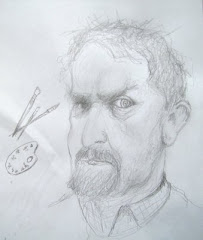
Would YOU pose for this man???
Exhibition Poster

Catterline Event, 2011
Oil Painting by Jim Tait
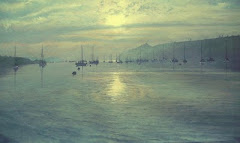
Helford River, Cornwall
Oil Painting by Jim Tait
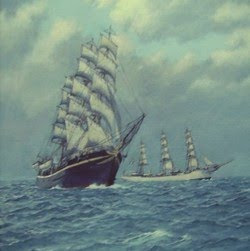
Full-riggers "Georg Stage" and "Danmark"
Other Recent Works
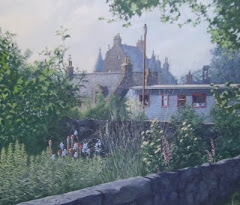
Fordyce Castle and Village

Hay's Dock, Lerwick

Shetland-model Boats at Burravoe, Yell
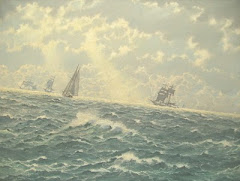
Tall Ships Seascape

The Tour Boat "Dunter III", with Gannets, off Noss
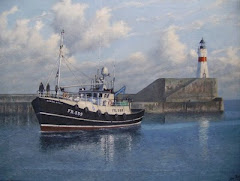
The "Karen Ann II" entering Fraserburgh harbour
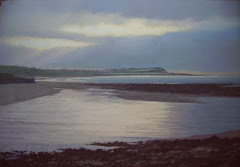
Summer Evening, Boyndie Bay
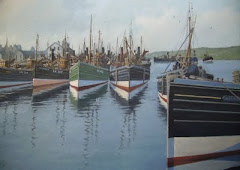
1930s Lerwick Harbour

Johnshaven Harbour
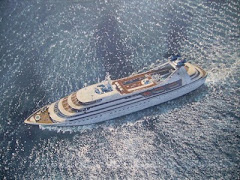
"Seabourn Legend"
Greeting Cards!

Now Available in Packs of Five or in Assorted Sets of Four
Showing posts with label fishing industry. Show all posts
Showing posts with label fishing industry. Show all posts
Sunday, 18 March 2012


Monday, 7 March 2011
HAZARDS OF SEAFARING

This is my version, in oils on canvas, of the Shetland fishing boat "Kildonan", passing the Bressay lighthouse as she approached Lerwick harbour. She would have done this many times in her short career. She was a 50-odd foot "zulu", built originally as a sailing vessel, and had been fitted with a wheelhouse and a diesel engine, as many of this class of boat were, in the years just following the first world war. One early summer morning in 1932, her crew had just finished hauling a good shot of herring, and one of the two brothers who owned the boat went down to start the engine for the short voyage back to the market at Lerwick. Instead of starting in the usual manner, it went on fire, the blaze spread quickly, and the crew had no option but to abandon ship and take to the small boat to watch their livelihoods go up in flames before their eyes. The skipper, whose daughter (now aged 80) commissioned the work from me, once said that the saddest sound he had ever heard was that of the drift-net buoys bursting in the intense heat.
No doubt fire-fighting equipment was much less sophisticated in those days than that carried as standard and by regulation now. In addition, there are the many other modern safety devices, without which no present-day skipper would ever even consider putting to sea. Some of this is electronic, some connected with advances in other fields of technology and communication, such as the EPIRB (Emergency Position Indicating Radio Beacon), whose prosaic title bears similarities to the "does exactly what it says on the tin" advertising slogan, all of it designed to improve the safety of mariners at sea.
And then there is, but not for much longer in its present form apparently, the Coastguard, a worthy organisation of people dedicated to keeping seafarers healthily afloat. They, being local to their station, know the coastline and the inshore waters in their local areas intimately, and have representatives on call at all times to deal with any emergency which may arise (and frequently does). Their radios and other points of contact are constantly manned to pick up signals from any vessel which might be in trouble, and they normally take control of any rescue operations which may have to be mounted in their areas, be it a ship in distress, a cliff fall or stranding (man or beast!), or a missing shore walker. In short, if anyone's safety is compromised, either at sea or near the shoreline, the coastguard is there to use its local knowledge and skills to put an effective rescue plan into motion.
Until now, that is. In order to save a few million quid, the coalition government wants to shut the local coastguard stations (the few that are left) down. Hapless beleaguered-looking representatives have been despatched to the various locations where the doomed stations are situated, with the remit to persuade the turkeys that voting for Christmas IS a good idea, that closing the stations is a wonderful scheme which will make the system SO much more efficient, and is NOTHING AT ALL to do with the fact that our rulers need to recoup the huge sums dished out to senior bankers as a reward for practically bankrupting the country, and putting seafarers' lives at risk is a price worth paying for this. They are having difficulty selling this to the natives, however. The deal is this - there will be one fully manned technology-driven unit in Aberdeen, and one other part-time 9 to 5-opening one at either Stornoway or Lerwick (fight amongst yourselves for that one, folks!). Tough if your job takes you to sea outwith these hours, as most seafarers' jobs do! Are there really people in Regulationville who think that seamen finish their eight-hour shift, change into their casuals and have a pint in the pub on the way home to the wife and kids?
Then there were the coastguard tugs (now off contract, I believe, and in the process of getting repainted for their new jobs), which were introduced in the aftermath of the "Braer" oil spill. They were to cover the sea areas around the Western and Northern Isles, to take broken-down ships (of which there have been many) in tow, thus guarding our coastlines against pollution, and crews' lives from being lost at sea in these busy areas. I almost laughed out loud when I heard about the Royal Navy nuclear submarine HMS "Astute" grounding off the Gairloch last year, and having to be towed off by one of the very ships they want to get rid of!
Of course, closing Coastguard stations is nothing new. The last government got rid of the Orkney station, amongst others, and in England, the National Coastwatch Institution, http://www.nci.org.uk/ was set up in 1994 as a kind of substitute for defunct Coastguard units. It is entirely staffed by unpaid volunteers and supported entirely by voluntary contributions (rather like the RNLI, it seems), but this body has no representation north of the border as yet, as far as I know. I hate the idea of this really, as it appears to let a Government of knaves and charlatans get away with their incompetence, mismanagement of resources, and callous indifference to the wellbeing of sailors and others who rely on them for a degree of protection. Once again, an essential service is being sacrificed on the altar of capitalism and consumerism. This is what David Cameron calls the "big society", after all - people who will work for nothing and let him "off the hook", to use a fishing expression.
Comparing the summer of 1932 with the present day in terms of safety at sea is not easy, and there are few similarities. Marine diesel engines were at an early stage of development back then. Rescue equipment was limited to a wooden lifeboat, a few lifebelts, the strong arms of the fishermen themselves and anything else that came to hand at the time! Nowadays there are advances in technology and safety devices too numerous to list here. This is just as well, for this government has made it clear that, as far as it is concerned, we could be back to the 1930s. The sea is still as dangerous a workplace as it ever was, and I hope that every time a life and/or a livelihood is lost with this evil coalition's tacit approval, they are left in no doubt of the fact. I am sure that the media, in its various forms, will be delighted to assist!
Subscribe to:
Posts (Atom)