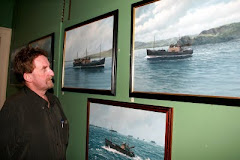
The title of this piece refers to the name given by Shetlanders to the north Mainland of Shetland (Mainland being the name of the largest island of the archipelago). Where exactly "nort trow" begins probably depends on whom you ask. To someone from Voe, it probably starts at the Mavis Grind isthmus, whereas to folk, like me, from Lerwick and the central and south of the island, it most probably begins at Voe or Brae. It is universally agreed that it ends at the Point of Fethaland, the most northerly point.
Wherever it begins, it was hither that my old school pal Robin Barclay and I hied on the morning of Tuesday 27th March. We had arranged to go for a run in Robin's 4 x 4, accompanied by our cameras, and the weather turned out exceptionally fine for our excursion. Robin is one of the old classmates who made up the hanging party for the ill-fated Catterline exhibition last November. As it turned out, the hanging was the only good part of it, but I couldn't have reasonably foreseen that at the time.
Last Tuesday we called first at Weisdale's Bonhoga Gallery to see what was on display there. We then continued on our way to Voe, where we gave our cameras their first exercise around the pier area. Lower Voe is one of the most attractive locations in Shetland, strongly evocative of Norwegian west coast villages with the maroon-painted wooden buildings clinging to the steep hillsides around the voe-head. We had an excellent bar lunch at the Pierhead Bar and Restaurant there.
At upper Voe, the main road splits into two, the right fork taking the traveller past Dales Lees to Firth, Mossbank and the north isles ferry terminal at Toft. We took the left turning, from which the road skirts Olna Firth, and then Busta Voe on its way through Brae. My intention had been to steer my old schoolmate in the direction of Muckle Roe, a place I had not visited since my last call there with the Bank of Scotland mobile unit around 1970. It turned out that Robin had never been there before, so we duly crossed the bridge and took the left turning which led us along the Busta Voe side of what used to be an island, access to which was gained by stepping stones (use of which must have been a hazardous undertaking in inclement weather!) until a footbridge was built in 1904, upgraded to take vehicular traffic after WWII. Judging by the fair number of new houses along the couple of miles of winding road between the bridge and the Little Ayre, Muckle Roe is now within easy daily commuting distance of the oil terminal and other mainland workplaces.
I have unfinished photographic business in Muckle Roe. I'd known it was a mistake to have that coffee after my meal at Voe, and my bladder was at bursting point by the time we got back to the bridge. Since no toilet facilities were evident, I had to employ the 4 x 4, on the mainland side, to shield myself from the eyes of the populace, as I pumped the bilges en plein air, so to speak. Duly relieved, it didn't seem appropriate to cross over again, so I got a few photographs of the bridge area, before we continued our run northwards. The weather was still beautiful, and it was only the grey colour of the ground which reminded us that March was not yet out.
We headed for Hillswick, and called at the craft shop, which was closed until May. We carried on west as far as Braewick, and I can't recall when I was last in this part of Shetland - probably never in better weather. Robin wanted to go to Ronas Voe, so it was back to Urafirth to get back on the road north. We ended up down on a "taing", known as the Blade (I found that out from an OS map afterwards) at Heylor, looking across at the red granite mass of Shetland's highest natural feature, Ronas Hill. A "skarf" was diving around the mussel ropes in the cobalt blue waters of the voe, and I found this place completely enchanting. As far as I can remember, I've never been at this lovely spot in my life before.
We toyed with the idea of heading even farther up to North Roe, but Robin reckoned there wasn't enough time left, as he had to be back in Sandwick around 5pm. We did call along Ollaberry on the way back south to Lerwick. The breeze had been gentle, the sunshine warm, and the day perfect. Sometimes I feel ashamed at how little I've seen of my native islands, and cross-country hiking will never be an option for me nowadays. However, it's amazing how much beautiful scenery can be enjoyed from close to the road. I'm looking forward to making more use of my camera, next time I'm "nort trow".
Now, as yesterday's snow is still clearing from the shady sides of the "hill-daeks", I recall the balmy conditions of a week ago, and ponder on the fickle nature of the Shetland weather. Fine days are not to be wasted here, and I'm glad I took full advantage of last Tuesday's sunshine. I hope we get some decent weather this summer, but I'm not holding my breath!
The Grumpy Old Artist
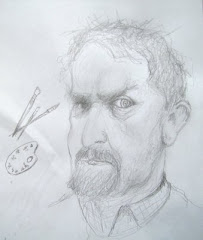
Would YOU pose for this man???
Exhibition Poster

Catterline Event, 2011
Oil Painting by Jim Tait
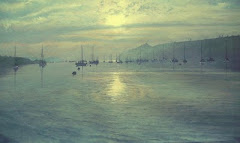
Helford River, Cornwall
Oil Painting by Jim Tait
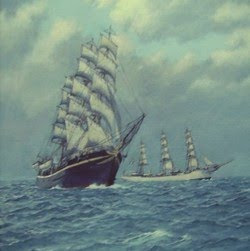
Full-riggers "Georg Stage" and "Danmark"
Other Recent Works
Fordyce Castle and Village

Hay's Dock, Lerwick

Shetland-model Boats at Burravoe, Yell
Tall Ships Seascape

The Tour Boat "Dunter III", with Gannets, off Noss
The "Karen Ann II" entering Fraserburgh harbour
Summer Evening, Boyndie Bay
1930s Lerwick Harbour

Johnshaven Harbour
"Seabourn Legend"
Greeting Cards!

Now Available in Packs of Five or in Assorted Sets of Four
Wednesday, 4 April 2012


Sunday, 25 March 2012
DISABILITY
Yesterday, as Shetland was shrouded in thick fog, which is still persisting as I write this, my sister Mary and I joined the rest of the mourners at the funeral of our first cousin Jeemie Nicolson. About 150 people gathered in the Scalloway Hall for this occasion, which was more enjoyable than most funerals I've attended. True, there were a few tears, but the singing was excellent, led by the North Ness Boys, with their mother Lorna playing the keyboard for the service. We all gave Jeemie, who had been so able physically and intellectually for most of his life, but had been largely absent in mind for the last few years, a rousing send-off as he embarked on his last voyage.
My memories of him will always be of a very able and talented man. I recall, as a boy, looking at his photographic slide-show of Sierra Leone, where he had been working as a mine geologist during happier times for that country in the 1960s. Later, when he took a share in acquiring Shetland's first purpose-built pelagic purse-seiner (the "Wave Crest", built in 1969), I used to go for trips to the herring fishing with her. How I enjoyed these overnight trips in pursuit of the shoals of herring. Slightly physically disabled, I would complete my day's work at the Bank of Scotland and, still in my bank suit, I would go aboard the boat for another adventure. I would witness the spectacle of two or three shots of herring being found, ensnared and brought aboard, and be back in Lerwick in time to start another shift at the bank in the morning. Happy days indeed! Later, Jeemie sold his share in the boat and began a new career as a successful author, columnist and editor. Then disability took possession of his mind, as it has taken many another brilliant one, but at least his writings remain as living testimony of his ability, for all the world to see.
Disability, whether in mind or body, is a subject fairly close to my heart. I had to remain seated for the whole of yesterday's service, as the hall seats were too low for me to get up quickly enough to stand for the entrance of the cortege and the hymn-singing. Someone in the row behind me (to whom I owe a debt of gratitude), along with Mary, lent the necessary assistance to get me on my feet again at the end of the proceedings. Disability is socially embarrassing!
My brother and my nephew still smile when they think of our niece's (or cousin's, in the case of our nephew!) wedding in the Long Room at Busta House, Brae, in late February of last year. They sat either side of me at the ceremony, and grabbed an arm each every time we were called to stand - it was so well done, I think that no-one noticed it was happening! Regrettably, neither of them could make it to Shetland for yesterday's service - despatches tend to be more difficult to plan for than matches.
My "krang" is host to a whole catalogue of minor ailments, all of which embarrass and debilitate to a degree. I have been asthmatic since pre-school days, and have also suffered from a condition known as miatonia congenita, which manifests itself in the form of a muscular spasm triggered by any sudden impact or movement. It has caused me to fall over on countless occasions when able-bodied people would just have staggered before quickly regaining balance. As a young man, I did my best to minimise the drain on confidence, which stems from this condition, through taking on jobs which involved physical labour, although I'm not sure what my bosses thought of my work performance!
After contracting mumps at the age of 11, I have been completely deaf in one ear (yes, this 'ere ear - and all the other jokes!). This means, in effect, that I hear in mono, whereas everyone else around me has stereo reception. In normal one-to-one contact, this presents no problem, but in social situations this can be crippling. At parties, even with a moderate amount of back ground noise, I can see people looking at me with their lips flapping, but I can't hear a word of what is being said to me. In my "courting" days, my ex-wife was highly amused by the lengths I'd go to to counteract this. If I found myself seated on the wrong side of her, I would develop an odd and intense interest in the wall behind us, in order to get my right ear inclined towards her! I suppose the fact that I was once married to a beautiful woman is tribute to the success of my efforts to counteract this disability.
At parties, after beginning to try lip-reading what everyone is trying to say to me, I tend to tire of this effort after a couple of hours and a few soda-pops, and drift off into a world of my own, this earning me the reputation of being either stuck-up, anti-social or just plain stupid, all of which are simply untrue. Debilitation and embarrassment go hand in hand here, and I avoid going to parties if I can.
Over the years, I have added a broken pinkie on my left hand (sustained at work in 1978 and undiagnosed by the overstretched A & E staff at the hospital), and an extremely painful condition in my right knee, which appeared suddenly in the spring of 2006, was only treated in late 2007, and which has left me a legacy of back problems due to the counteractive measures I took to maintain some sort of forward momentum on foot during the eighteen months I endured the pain from my knee. I've never quite recovered my former strength of limb, and it's this that makes getting to my feet, from a low seated position, so difficult. Exercise helps, but I'm stuck with the social immobility of disability, and I empathise with others who are similarly affected.
My mother, now well through her 96th year, returns from a fortnight's respite care tomorrow, and I hope to be able to help her settle in back home at Whiteness. She has suffered from arthritis (including numerous replacement operations) for at least half of her long lifespan, and has had severe mobility issues for the last two decades. For now, I'll settle for being fit enough to paint pictures, post to this blog, and give my mother the help she needs to make her life tolerable.
My memories of him will always be of a very able and talented man. I recall, as a boy, looking at his photographic slide-show of Sierra Leone, where he had been working as a mine geologist during happier times for that country in the 1960s. Later, when he took a share in acquiring Shetland's first purpose-built pelagic purse-seiner (the "Wave Crest", built in 1969), I used to go for trips to the herring fishing with her. How I enjoyed these overnight trips in pursuit of the shoals of herring. Slightly physically disabled, I would complete my day's work at the Bank of Scotland and, still in my bank suit, I would go aboard the boat for another adventure. I would witness the spectacle of two or three shots of herring being found, ensnared and brought aboard, and be back in Lerwick in time to start another shift at the bank in the morning. Happy days indeed! Later, Jeemie sold his share in the boat and began a new career as a successful author, columnist and editor. Then disability took possession of his mind, as it has taken many another brilliant one, but at least his writings remain as living testimony of his ability, for all the world to see.
Disability, whether in mind or body, is a subject fairly close to my heart. I had to remain seated for the whole of yesterday's service, as the hall seats were too low for me to get up quickly enough to stand for the entrance of the cortege and the hymn-singing. Someone in the row behind me (to whom I owe a debt of gratitude), along with Mary, lent the necessary assistance to get me on my feet again at the end of the proceedings. Disability is socially embarrassing!
My brother and my nephew still smile when they think of our niece's (or cousin's, in the case of our nephew!) wedding in the Long Room at Busta House, Brae, in late February of last year. They sat either side of me at the ceremony, and grabbed an arm each every time we were called to stand - it was so well done, I think that no-one noticed it was happening! Regrettably, neither of them could make it to Shetland for yesterday's service - despatches tend to be more difficult to plan for than matches.
My "krang" is host to a whole catalogue of minor ailments, all of which embarrass and debilitate to a degree. I have been asthmatic since pre-school days, and have also suffered from a condition known as miatonia congenita, which manifests itself in the form of a muscular spasm triggered by any sudden impact or movement. It has caused me to fall over on countless occasions when able-bodied people would just have staggered before quickly regaining balance. As a young man, I did my best to minimise the drain on confidence, which stems from this condition, through taking on jobs which involved physical labour, although I'm not sure what my bosses thought of my work performance!
After contracting mumps at the age of 11, I have been completely deaf in one ear (yes, this 'ere ear - and all the other jokes!). This means, in effect, that I hear in mono, whereas everyone else around me has stereo reception. In normal one-to-one contact, this presents no problem, but in social situations this can be crippling. At parties, even with a moderate amount of back ground noise, I can see people looking at me with their lips flapping, but I can't hear a word of what is being said to me. In my "courting" days, my ex-wife was highly amused by the lengths I'd go to to counteract this. If I found myself seated on the wrong side of her, I would develop an odd and intense interest in the wall behind us, in order to get my right ear inclined towards her! I suppose the fact that I was once married to a beautiful woman is tribute to the success of my efforts to counteract this disability.
At parties, after beginning to try lip-reading what everyone is trying to say to me, I tend to tire of this effort after a couple of hours and a few soda-pops, and drift off into a world of my own, this earning me the reputation of being either stuck-up, anti-social or just plain stupid, all of which are simply untrue. Debilitation and embarrassment go hand in hand here, and I avoid going to parties if I can.
Over the years, I have added a broken pinkie on my left hand (sustained at work in 1978 and undiagnosed by the overstretched A & E staff at the hospital), and an extremely painful condition in my right knee, which appeared suddenly in the spring of 2006, was only treated in late 2007, and which has left me a legacy of back problems due to the counteractive measures I took to maintain some sort of forward momentum on foot during the eighteen months I endured the pain from my knee. I've never quite recovered my former strength of limb, and it's this that makes getting to my feet, from a low seated position, so difficult. Exercise helps, but I'm stuck with the social immobility of disability, and I empathise with others who are similarly affected.
My mother, now well through her 96th year, returns from a fortnight's respite care tomorrow, and I hope to be able to help her settle in back home at Whiteness. She has suffered from arthritis (including numerous replacement operations) for at least half of her long lifespan, and has had severe mobility issues for the last two decades. For now, I'll settle for being fit enough to paint pictures, post to this blog, and give my mother the help she needs to make her life tolerable.
Sunday, 18 March 2012
LET'S MAKE A DATE!
Scotland's glorious leader, King Alex 1, is fond of his dates. I don't mean the brown sticky things that used to come in long-shaped tins and which I decided, at a very tender age, were never going to be part of my staple diet. I mean significant dates in Scottish history, such as that of the battle of Bannockburn, on the 700th anniversary of which he plans to hold the "independence" referendum. On that momentous day (the 24th June 2014 - I looked it up!), he hopes, Scotland will become a nation again.
I've got news for him - Scotland will never be a sovereign state as long as it is subject to the tyrannous rule of the European Union. To be a sovereign state, one has to have complete freedom of legislature, executive and judiciary, the constitutional elements in which the independence of a nation is enshrined. But King Ted sold all three of them down the river Rhine on January 1st 1973 (there's another good date for King Alex). Since then, the UK can only legislate as far as the lords and masters of Brussels and Strassbourg will graciously allow, the executive (civil service) is similarly constrained in its actions, and our judiciary (of which Scotland could once be justly proud) is now subject to whatever overturning edicts might emanate from that august, weird and wonderful institution known as the European Court of Human Rights (whatever that consists of). When I hear politicians talking about British sovereignty, I wonder who they think they're kidding!
Now the winds of change are blowing through Europe (to misquote Harold Macmillan out of context!). The financial systems of weaker member "states" are destined for meltdown, one by one, unable to adjust to the strength of the euro, and ending up in hock to the more robust systems, led by that of Germany, which will succeed in doing financially what Hitler failed to do militarily, and completely control the rest of Europe. Once again, the UK will survive, after a fashion, not having signed up to the euro. Perhaps King Alex has been smarter, in his intended adherence to the pound, than I have been giving him credit for.
All that is some distance down the rocky road. In the meantime, King Alex will only reign over a satellite European province, attached geographically to a slightly bigger UK satellite, and his government will have no more power than a provincial administration. He's very Scottish, King Alex. The trouble is I feel no Scottish blood coursing through my veins, and I shudder to think what will happen to my beloved Shetland Islands, when and if Scotland votes "aye" to "independence" (which is what most aye-voters are being led to think they are voting for!). Shetland stood practically alone in voting "nein" to European integration back in the 1970s, and I confidently predict that it will vote "nah" to Scottish "independence" too. Not that this will make much difference - Shetland will be dragged to whatever grisly fate awaits Scotland in the years to come, and our islands now have a big part to play in King Alex's plans!
I've got another date for King Alex - well, it's only a year, actually, as, to the best of my knowledge, the day and month are not a matter of record. It is 2018, when it will be 550 years since Shetland and Orkney were pledged to Scotland by a cash-strapped King of Denmark, who was obliged to provide a dowry for his daughter Margaret's marriage to James III of Scotland in 1468. It was only a pledge, redeemable on production of 20 florins of the Rhine, which the Danish monarch didn't have handy at the time. Somehow it was never redeemed, and the northern isles have remained politically attached to Scotland ever since. And for some time after the wedding, Shetland had a pretty bad hangover under the yoke of the Stewart kings' cousins, who were in charge of administration of the newly-acquired territory.
Now Shetland has something that King Alex badly wants - a rather lucrative arrangement with the companies which are producing most of "Scotland's oil" around our far-flung islands. The fields such as the Forties, Claymore and Tartan complexes off Aberdeen are past their peak production, and Scotland needs revenue from the northern North Sea and the new Continental Shelf exploration areas, because without it he hasn't got enough funds to fuel the projects which the SNP were rashly promising prospective voters at their recent party conference. The trouble is, who is going to do the negotiations for the islands this time around? I think that King Alex may just have the edge over us this time.
There are difficult times ahead for my beloved Shetland Islands. The fishing industry, which was once Shetland's biggest employer, is under more and more pressure from insane legislation emanating from a completely unsympathetic European Union, which, in turn, takes the advice of a multitudinous arraignment of conservation lobbyists and wildlife pressure groups (who gain most of their support from ill-informed and emotionally charged city dwellers), who would have the whole of the sea around our shores designated as a protected area for tourists to gawp at predatory species of marine mammals and seabirds. Most fishermen (the most endangered of all species!) have now left the industry to work in the aquaculture and oil industries, and the few remaining Shetland boats are frequently crewed by eastern Europeans, Filipinos and Africans. To compound the problem, other European member states do not feel obliged to be constrained by European fisheries legislation, and countries outside the EU are awarding themselves vastly inflated quotas for their fleets, further applying pressure to finite fish stocks.
Our other indigenous occupations, such as crofting and knitwear manufacture, are also in decline, and our own oil terminal is seeing its throughput steadily decreasing. According to some folk involved in the industry, Shetland is pricing itself out of the forthcoming oil installation decommissioning work. Vociferous organisations of nimbies, who see Shetland as somehow sustainable as a guano-covered rock in the ocean (perhaps they see fertiliser production as a new industry!) are doing their level best to prevent renewable energy projects from getting established. Tourism is vastly overrated as a source of income for anyone who doesn't provide accommodation or passenger transport. Just ask anyone who runs a small retail outlet how much he/she makes from tourists, and I can pretty much guarantee that the answer will be somewhere in the "not a lot" category.
In fact, I predict that the main occupations of Shetland residents during the reign of King Alex I of Scotland will be drug dealing and the inevitable consequences thereof. The increased workload of the Shetland Islands Council's Social Work Department and the NHS will no doubt provide employment for some.
On the glorious 14th June 2014, King Alex I hopes that Scotland will vote "Aye!" and start building the polytunnels which will help sustain it during its future as an oil-fired banana republic. There isn't anything else - most Scottish indigenous industry has either disappeared or is in the process of vanishing. But what the heck! Scotland will be a nation again - well, sort of! If it could negotiate independence from Europe, it might achieve independent nation status, for what that's worth. But that isn't part of King Alex's plan, is it? Unfortunately, Shetland IS part of it, and I wish, with all my heart, that my beloved islands had a plan B.
I've got news for him - Scotland will never be a sovereign state as long as it is subject to the tyrannous rule of the European Union. To be a sovereign state, one has to have complete freedom of legislature, executive and judiciary, the constitutional elements in which the independence of a nation is enshrined. But King Ted sold all three of them down the river Rhine on January 1st 1973 (there's another good date for King Alex). Since then, the UK can only legislate as far as the lords and masters of Brussels and Strassbourg will graciously allow, the executive (civil service) is similarly constrained in its actions, and our judiciary (of which Scotland could once be justly proud) is now subject to whatever overturning edicts might emanate from that august, weird and wonderful institution known as the European Court of Human Rights (whatever that consists of). When I hear politicians talking about British sovereignty, I wonder who they think they're kidding!
Now the winds of change are blowing through Europe (to misquote Harold Macmillan out of context!). The financial systems of weaker member "states" are destined for meltdown, one by one, unable to adjust to the strength of the euro, and ending up in hock to the more robust systems, led by that of Germany, which will succeed in doing financially what Hitler failed to do militarily, and completely control the rest of Europe. Once again, the UK will survive, after a fashion, not having signed up to the euro. Perhaps King Alex has been smarter, in his intended adherence to the pound, than I have been giving him credit for.
All that is some distance down the rocky road. In the meantime, King Alex will only reign over a satellite European province, attached geographically to a slightly bigger UK satellite, and his government will have no more power than a provincial administration. He's very Scottish, King Alex. The trouble is I feel no Scottish blood coursing through my veins, and I shudder to think what will happen to my beloved Shetland Islands, when and if Scotland votes "aye" to "independence" (which is what most aye-voters are being led to think they are voting for!). Shetland stood practically alone in voting "nein" to European integration back in the 1970s, and I confidently predict that it will vote "nah" to Scottish "independence" too. Not that this will make much difference - Shetland will be dragged to whatever grisly fate awaits Scotland in the years to come, and our islands now have a big part to play in King Alex's plans!
I've got another date for King Alex - well, it's only a year, actually, as, to the best of my knowledge, the day and month are not a matter of record. It is 2018, when it will be 550 years since Shetland and Orkney were pledged to Scotland by a cash-strapped King of Denmark, who was obliged to provide a dowry for his daughter Margaret's marriage to James III of Scotland in 1468. It was only a pledge, redeemable on production of 20 florins of the Rhine, which the Danish monarch didn't have handy at the time. Somehow it was never redeemed, and the northern isles have remained politically attached to Scotland ever since. And for some time after the wedding, Shetland had a pretty bad hangover under the yoke of the Stewart kings' cousins, who were in charge of administration of the newly-acquired territory.
Now Shetland has something that King Alex badly wants - a rather lucrative arrangement with the companies which are producing most of "Scotland's oil" around our far-flung islands. The fields such as the Forties, Claymore and Tartan complexes off Aberdeen are past their peak production, and Scotland needs revenue from the northern North Sea and the new Continental Shelf exploration areas, because without it he hasn't got enough funds to fuel the projects which the SNP were rashly promising prospective voters at their recent party conference. The trouble is, who is going to do the negotiations for the islands this time around? I think that King Alex may just have the edge over us this time.
There are difficult times ahead for my beloved Shetland Islands. The fishing industry, which was once Shetland's biggest employer, is under more and more pressure from insane legislation emanating from a completely unsympathetic European Union, which, in turn, takes the advice of a multitudinous arraignment of conservation lobbyists and wildlife pressure groups (who gain most of their support from ill-informed and emotionally charged city dwellers), who would have the whole of the sea around our shores designated as a protected area for tourists to gawp at predatory species of marine mammals and seabirds. Most fishermen (the most endangered of all species!) have now left the industry to work in the aquaculture and oil industries, and the few remaining Shetland boats are frequently crewed by eastern Europeans, Filipinos and Africans. To compound the problem, other European member states do not feel obliged to be constrained by European fisheries legislation, and countries outside the EU are awarding themselves vastly inflated quotas for their fleets, further applying pressure to finite fish stocks.
Our other indigenous occupations, such as crofting and knitwear manufacture, are also in decline, and our own oil terminal is seeing its throughput steadily decreasing. According to some folk involved in the industry, Shetland is pricing itself out of the forthcoming oil installation decommissioning work. Vociferous organisations of nimbies, who see Shetland as somehow sustainable as a guano-covered rock in the ocean (perhaps they see fertiliser production as a new industry!) are doing their level best to prevent renewable energy projects from getting established. Tourism is vastly overrated as a source of income for anyone who doesn't provide accommodation or passenger transport. Just ask anyone who runs a small retail outlet how much he/she makes from tourists, and I can pretty much guarantee that the answer will be somewhere in the "not a lot" category.
In fact, I predict that the main occupations of Shetland residents during the reign of King Alex I of Scotland will be drug dealing and the inevitable consequences thereof. The increased workload of the Shetland Islands Council's Social Work Department and the NHS will no doubt provide employment for some.
On the glorious 14th June 2014, King Alex I hopes that Scotland will vote "Aye!" and start building the polytunnels which will help sustain it during its future as an oil-fired banana republic. There isn't anything else - most Scottish indigenous industry has either disappeared or is in the process of vanishing. But what the heck! Scotland will be a nation again - well, sort of! If it could negotiate independence from Europe, it might achieve independent nation status, for what that's worth. But that isn't part of King Alex's plan, is it? Unfortunately, Shetland IS part of it, and I wish, with all my heart, that my beloved islands had a plan B.
Sunday, 12 February 2012
THE "HARVEST HOPE"

The "Harvest Hope" was built in 1949 by Stephens of Banff for Alex and Robert Duthie of Lerwick. She was 57ft long and 27 tons gross and net. She is pictured approaching the north mouth of Lerwick harbour in strong north-westerly winds, with the Green Holm and the Brethren skerries to port in the background.
Sunday, 29 January 2012
WOOF!

I copied it fairly slavishly from the little snapshot given me by the client, as my knowledge of the anatomy and bearing of dogs is limited. I don't even like the brutes - I've stood once too often in their produce, deposited, as it normally is, on street corners and outside peoples' gates. I would not care to encounter, on a dark night, the hound of hell which regularly drops its considerable bundle outside the Burgh Road gate of the Gilbertson Park here in Lerwick. I would, however, very much like to identify its owner, as the mutt is in flagrante delicto, so to speak. The satisfaction I would derive from his/her wallet depletion, on having his/her collar felt by the authorities, would be immense.
Someone offered me a dog once - probably in the pub, which is the place where I've had most of my interesting offers. I replied that I was more than capable of doing all my own fouling, howling, slavering and whining, as most of my friends will testify. The offerer seemed somewhat put out by this reply, although as to which part of it perplexed her, I'm not absolutely certain.
I can get quite curmudgeonly about dog owners, who confuse slavish obedience with intelligence in their pets. They'll demonstrate how "clever" their shitsus are, as they artlessly respond to commands to roll over, do somersaults, jump over obstacles or whatever the whim of the dictatorial poochmaster might be.
Give me a haughty, supercilious and indifferent pussy-cat any day. You can shout, point, whistle and gesticulate at a cat all you like, and it will merely regard you coolly, as if you have gone completely mad, give a disdainful tail-flick and carry on with whatever it was doing before it was so rudely interrupted. Now that's intelligence - coupled with style - for you!
I wish all you cool cats (and your pets!) a happy and successful week.
Wednesday, 11 January 2012
THE TEMPEST
A happy new year! If I made a resolution (which I haven't for at least a decade - they're a waste of time for weak-willed people like me!) it should have been to post more regularly to this blog. I'll do my best, but my good intentions are too often thwarted by events happening around me.
While most of Britain was mopping up and compiling statistics for insurance claims after the new year storms, Shetland was basking in a relatively quiet spell of weather, with winds not reaching much more than gale force. We, in the Northern Isles, took our pounding on Christmas Day, and we had it more or less all to ourselves. From the Met office figures for the day, I gathered that there had been a mean wind speed of over 60mph from 2pm until 7pm, with gusts in excess of 90mph in Lerwick, and over 100mph in other locations in the islands.
We had our usual gathering at my mother's house, where her son, daughter, grand-daughter, grandson-in-law and two great-grandchildren (excellent entertainment, as always!) had assembled to attempt a demolition job, in true traditional style, on a turkey and trimmings, followed by sticky toffee pudding. Fortunately, the cooking had been done, and we were in the process of washing up, before problems with the mains electricity supply began to manifest themselves. Most of the west side of the island was plunged into darkness at around 5 o'clock.
By this time, we'd had the foresight to get the gas heater going in the kitchen, as the oil-fired central heating system (which is becoming rather elderly) had lost its pilot ignition due to the high winds. Most of the other family members had left to get home around 4pm, leaving me with mother. I found candles and an oil lamp, which provided enough light to guide us from room to room. Just as I was about to see if I could get the gas ring in the scullery going to make us a cuppa, the mains power came back on long enough for me to get a pot of tea "trackit" on the electric cooker. Then off went the power again! It came on again at about 8pm, and this time it stayed on. By then the wind had moderated to a mere storm force, and it abated quite rapidly from then on. Around 9pm, I was able to coax the central heating back on to stay.
My sister Mary, whose power was still off at Strand, Tingwall, came back to give me a lift back to Lerwick, as she had friends she wanted to visit there. Coming over the top of Wormadale, it was rather eerie to see the areas, which still had mains power, glowing brightly, while other places were intensely blacked out. We came upon a "Hydro" landrover, orange lights flashing, moving slowly down the hill, very close to the verge, obviously using detection equipment to locate mains ruptures.
It was a different kind of Christmas Day from the previous two (both white!), and I was glad I'd been there to help out at mother's. I had a look around the place in quieter weather last Friday and, as far as I can make out, there was no structural damage, which surprised me a little, as a lesser storm, a few weeks ago, had caused quite a bit of minor mayhem. All in all, I think I prefer the fierce winds to the snow of the 2009 and 2010 yuletides - the white stuff causes more problems in getting around. The heroic "hydro" workers, who were spending their holiday out in the tempest, repairing faults, might not agree!
While most of Britain was mopping up and compiling statistics for insurance claims after the new year storms, Shetland was basking in a relatively quiet spell of weather, with winds not reaching much more than gale force. We, in the Northern Isles, took our pounding on Christmas Day, and we had it more or less all to ourselves. From the Met office figures for the day, I gathered that there had been a mean wind speed of over 60mph from 2pm until 7pm, with gusts in excess of 90mph in Lerwick, and over 100mph in other locations in the islands.
We had our usual gathering at my mother's house, where her son, daughter, grand-daughter, grandson-in-law and two great-grandchildren (excellent entertainment, as always!) had assembled to attempt a demolition job, in true traditional style, on a turkey and trimmings, followed by sticky toffee pudding. Fortunately, the cooking had been done, and we were in the process of washing up, before problems with the mains electricity supply began to manifest themselves. Most of the west side of the island was plunged into darkness at around 5 o'clock.
By this time, we'd had the foresight to get the gas heater going in the kitchen, as the oil-fired central heating system (which is becoming rather elderly) had lost its pilot ignition due to the high winds. Most of the other family members had left to get home around 4pm, leaving me with mother. I found candles and an oil lamp, which provided enough light to guide us from room to room. Just as I was about to see if I could get the gas ring in the scullery going to make us a cuppa, the mains power came back on long enough for me to get a pot of tea "trackit" on the electric cooker. Then off went the power again! It came on again at about 8pm, and this time it stayed on. By then the wind had moderated to a mere storm force, and it abated quite rapidly from then on. Around 9pm, I was able to coax the central heating back on to stay.
My sister Mary, whose power was still off at Strand, Tingwall, came back to give me a lift back to Lerwick, as she had friends she wanted to visit there. Coming over the top of Wormadale, it was rather eerie to see the areas, which still had mains power, glowing brightly, while other places were intensely blacked out. We came upon a "Hydro" landrover, orange lights flashing, moving slowly down the hill, very close to the verge, obviously using detection equipment to locate mains ruptures.
It was a different kind of Christmas Day from the previous two (both white!), and I was glad I'd been there to help out at mother's. I had a look around the place in quieter weather last Friday and, as far as I can make out, there was no structural damage, which surprised me a little, as a lesser storm, a few weeks ago, had caused quite a bit of minor mayhem. All in all, I think I prefer the fierce winds to the snow of the 2009 and 2010 yuletides - the white stuff causes more problems in getting around. The heroic "hydro" workers, who were spending their holiday out in the tempest, repairing faults, might not agree!
Sunday, 8 January 2012
STEAM DRIFTER "STEPHENS" FROM INVERALLOCHY

At 87 feet in length, the steel-built vessel was built in 1911 by A Hall & Co., Aberdeen, as the Inverness-registered "Vale o' Moray". A long and varied career followed, which saw her requisitioned for Admiralty service in two world wars, as well as having at least six different owners and three changes of name in "civilian" life, finally being scrapped in Norway in 1955. The painting shows her in mid-career, when she was registered in Inverallochy.
Subscribe to:
Posts (Atom)